Showing posts with label SEO. Show all posts

Thursday, May 16, 2013

Beyond Search Rankings: Using SEO to Improve Site Optimization

The evolution of search engine algorithms has added to the complexity of search engine optimization. More significantly, it has impacted the level of integration that is needed with other forms of Web optimization. SEOMoz has a great page that shows the updates year by year.
Search engine optimization is no longer strictly about publishing quality content and building the authority of the content. SEO now involves engaging consumers and building relationships.
The new paradigm of SEO is that it must be implemented in tandem with other website optimization efforts. These include user experience design and social media marketing.

Optimizing for the Desired User Action

optimizing for the desired user action


Getting qualified traffic to a website is only half the battle; once visitors arrive, they need to perform an action. Whatever the desired action may be, whether it’s filling out a lead form, signing up for a newsletter or completing a purchase, the landing pages and the site in general must be optimized in such a way that makes the desired action clear and compelling to visitors. Otherwise, the SEO efforts and investment that drove people to the site will have been done in vain.
Given the importance of both driving traffic to a website and influencing that traffic to execute a conversion, it is important not to think of these as two mutually exclusive tasks. The ability to drive traffic is partially dependent on the actions completed once visitors land on a website.
The engagement value of a website is a ranking factor. If a website has low engagement, the site’s organic search rankings can be negatively affected. For example, search engines can easily determine that a website has a high bounce rate if users click on an organic listing then quickly return to the search engine results page. This is a strong signal to the search engines that the site has either poor-quality content or simply provides a bad user experience and, therefore, the search engine will no longer want to send its users to that site. This results in lowered rankings. For this reason, it is essential that SEO efforts are integrated with usability/user experience optimization.
Integrating Social Media and SEO
integrating social media and SEOAnother important area of necessary integration with SEO is social media marketing efforts. Social signals, such as Likes, Tweets, +1’s, etc. are strong authority signals in the eyes of search engines. Furthermore, it is important to build strong relationships with consumers via SEO and maintain those relationships through social media. By building strong social communities and engaging with those communities, search engines will view a brand as a positive destination for its users and those connected to the brand’s followers will be more likely to come across and engage with the brand.
The integration between SEO and social media marketing that should always happen includes facilitating website visitors to join a brand’s social communities by prominently placed social media buttons and links on the website. If performed correctly, visitors driven to the site by SEO efforts can be leveraged for building a stronger social presence for the brand. Alternatively, website content meant to generate organic traffic should be shared via the brand’s social media profiles/communities to build authority to that content, increasing the SEO value.
These are just a few examples of various Web optimization principles and channels that should be integrated with SEO.
SEO should not be viewed as a stand-alone channel for inbound marketing, but rather part of a larger digital strategy that is fully integrated. Allow SEO to help other channels succeed and allow other channels to benefit SEO.

5 Link Building Tactics that Buck the Content Marketing Trend

Content marketing is undoubtedly one of the most powerful ways to attract attention and build links in the modern era, but by no means is it the only option, nor is it necessarily always the best choice. In fact, placing too much emphasis on content can actually distract from what we should be doing most: approaching the unique needs of each client and niche.
With that in mind, we’ve put together five approaches to link building that aren’t designed around “content,” at least not in the traditional sense. Let’s get started.

Tactic #1: Build a Community

To be fair, this approach gets quite a bit of attention from the SEO community nowadays, and isn’t exactly a “neglected” strategy. That said, few online marketers have quite mastered this one, and it’s definitely worth talking about.
I won’t spend too much time talking about how you should engage your audience on Facebook and Twitter, ask and answer questions on forums or Q&A sites, and generally just get involved in “the conversation.” Hopefully you’ve heard all of it already. Instead, I’m going to talk about two of the more neglected parts of community building: reaching out to influencers, and building native communities.
Reaching out to influencers
Few SEOs worth their weight in salt are strangers to outreach. We all understand how important it is to contact influential people. Unfortunately, this is usually done with a singular goal in mind: to get a guest post.
I recommend you start thinking bigger. Look at the relationships between Rand of SEOmoz, Will of Distilled, and Danny Sullivan at Search Engine Land. These are influential people who frequently talk to each other and mention each other within their content. They often meet in person and attend each other’s events.
These are the kinds of relationships that seriously impact your community building efforts. When you borrow the trust and authority of an influencer within your niche, you have an opportunity to expand your persistent reach that is simply impossible to accomplish in any other way.
Start building relationships with influencers. Don’t be afraid to use email or, *gasp*, the phone to solidify these relationships. When possible, meet in person. This leads to the kind of long term collaboration that you can’t get out of a guest post.
Building a native community
How solid is your community? SEO Book’s community is so solid that people are willing to pay to stay a part of it. This is the kind of community that you need to build, and it’s not going to happen on a social network.
Don’t misunderstand: social networks are a great place to expand your reach, but I’m of the opinion that you’re job’s not finished (as though it ever is) until you’ve build a community on your own web property.
You can do this with blog comments alone, but this can be limiting and isn’t always the best option. Setting up a forum or Q&A section on your own site can be an incredibly powerful way to solidify your online community. Granted, it takes a lot of work to pull users off of their social network or the blog comment page onto your forum in the beginning, when it’s empty, but it’s worth the payoff.
Remember, forums are all about conversation. Once you build a strong base of just a few regulars, the rest is easy. So, once again, put the focus on that relationship building.
Forums aren’t the only option. Look to Wikipedia, Cheezburger , or QuickMeme for even better examples. These sites give their core users the ability to create something of their own with ease, and a native community naturally follows.

Tactic #2: Tools That Trump Content

Before I start a flame war here, I’m not arguing that tools aren’t “content.” Google certainly sees them that way, and when a tool suits the user’s purpose better than a blog post, it’s even the optimal kind of content.
That said, content marketers rarely talk about tools, and SEOs and inbound marketers in general tend to think the same way. To us, content = blog posts, infographics, videos, and white papers. Tools tend to be the last thing that comes to mind, and that’s a mistake.
Just look at the most linked to sites on the web. Tools are everywhere. Most of the top sites on the web are most accurately described as tools or communities (usually both). They aren’t content sites like the Huffington Post or Cracked (though those are great examples of content done right).
Tools can be incredible community building assets, as we already mentioned with Wikipedia, Cheezburger, and QuickMeme. Not to mention, you know, Facebook, YouTube and WordPress.
A tool may also serve a searcher’s purpose better than traditional content. Sometimes a specialized calculator or an app is going to be more useful than a blog post (though certainly not always). Polls and other interactive media are also underutilized.

Tactic #3: Gamification

In 2011, over 70 percent of Forbes Global 2000 companies planned to implement gamification in some way. The fascination with gamification may have been driven by Zynga’s rapid rise to power. Its subsequent fall from grace seems to have hampered the trend, and you don’t see as much talk about gamification as you used to.
Part of that was failed design. Most companies that employed gamification put all of the focus on rewards system, and it became little more than an extension of existing ideas like company loyalty programs.
Perhaps Jane McGonigal was right to distance herself from the word gamification, and push the phrase “gameful design” instead.
Granted, forum point systems and badges (like Reddit karma) can do a great deal to compel users to come back, but the concept of the reward system got pushed so hard that marketers lost sight of the “fun” part of gaming. It was all about building compulsion loops that may have kept people coming back for a while, but eventually burnt them out, much like Zynga did.
To truly embrace gamification (or, perhaps, “gameful design”) you need to put the focus on gameplay. The video game industry has been larger than the movie industry for quite some time, and it’s not because of the badges and points (which very few gamers care about). It’s because the game itself is rewarding.
A genuinely gamified web presence doesn’t compel users to come back with points and badges for referrals. It creates a fun and interactive experience. The UI itself is fun to interact with.
Take Perrier’s Secret Place as an example. This is a literal online game that puts you on a hunt for clues to find a “secret” Perrier bottle. Finding the bottle does get you a chance to win a trip, but the itself is fun to play.
You don’t necessarily need to take things as far as designing a full-fledged game, but an understanding of game mechanics and gameplay is vital if you want to create a truly gamified experience. Rewards and badges alone can certainly lead to some success, but a truly captivating experience is what’s going to pull in the serious links.

Tactic #4: Hold a Contest or Eye-Grabbing Promotion

This one’s nothing new and I’m not going to spend too much time on it, but it’s worth mentioning because it can work very effectively.
Just to give an example of how this can work, consider what Queensland did a few years ago. To promote tourism, they offered a contest to win the “best job in the world,” where they would get paid AU$100,000 to go on holiday for half a year in Queensland, while blogging and making a video diary about all the fun they were having. The winner was chosen based on support from the public, so the best promoter was the winner. This attracted tons of attention and links for the site.
For more on contests, we like what Social Media Examiner has had to say. While this post is about Facebook, the same basic rules apply to any online contest.

Tactic #5: Traffic, Traffic, Traffic

Finally, one of the most surefire ways to get natural links is to simply pummel your site with traffic. This is the simple law of numbers at work. The more people who visit your site, the more links you will get.
Yes, we know, you want the links in order to get the traffic, not the other way around. We get it, and we get why this tactic isn’t everybody’s favorite.
Still, the organic search results aren’t the only source of traffic out there. You can send enormous amounts of traffic to your site if you start putting the focus on referral traffic, not manual links. There are several ways to go about this:
  • Shift your manual link building efforts toward permanent referral traffic, even if it means buying no-follow links.
  • Buy traffic from Facebook and niche specific display ads (Yes, it does work as a link building tactic).
  • Optimize your advertising spend for the most clicks instead of the highest (short-term) profit margins.
This approach gets tremendous resistance because you don’t have direct control over the links, but that’s kind of the point. These are exactly the kinds of links Google wants to see: links that occurred serendipitously.
You can afford to cut short term profits in order to attract additional traffic for exposure and links. All link building tactics cost money. Remember that.

Conclusion

Yes, the SEO industry is moving toward content marketing as a frontier for growth, but there are plenty of other inbound marketing strategies that can be leveraged to build links. Remember to approach each situation uniquely, without getting too caught up in trends.
What link building tactics are you using that aren’t driven by content marketing trends?

An Online Resource You Don’t Want to Miss: The Matt Cutts Short Cutts

It’s hard to believe that this topic has never been discussed on Search Engine Journal, but it looks as though one of my favorite resources, The Short Cutts, managed to miss this blog. It has been the subject of discussion for many SEOs since day one, but
it hasn’t taken long to realize that many businesses and individuals are still in the dark about this new resource. If you haven’t heard of the tool—don’t sweat it. This online resource has only been around since March of this year, so many are still getting used to how it works. It takes less than 2 minutes to master because it focuses on being “easy.” It’s very, very easy.

Why The Short Cutts Matters

The Short Cutts works as somewhat of an online directory of videos created by the head of the Google Webspam Team himself, Matt Cutts. The website is by popular online marketing company Click Consult who saw a need to organize these videos. It was becoming clear that the very helpful videos created by Cutts were beginning to get jumbled because there were so many. Since 2009, Cutts has created over 500 videos.
To give you a little bit of background information about these videos: Cutts typically takes Google user and webmaster questions on anything ranging from SEO to web design and development to Google penalties, etc. The videos are typically only 2-3 minutes long and feature Cutts giving his best answer to the question. Despite how vague he may seem to be at times with his answers, everyone knows that hearing from the man in charge is information work noting. With this notion in mind, The Short Cutts was created.

How The Short Cutts Works

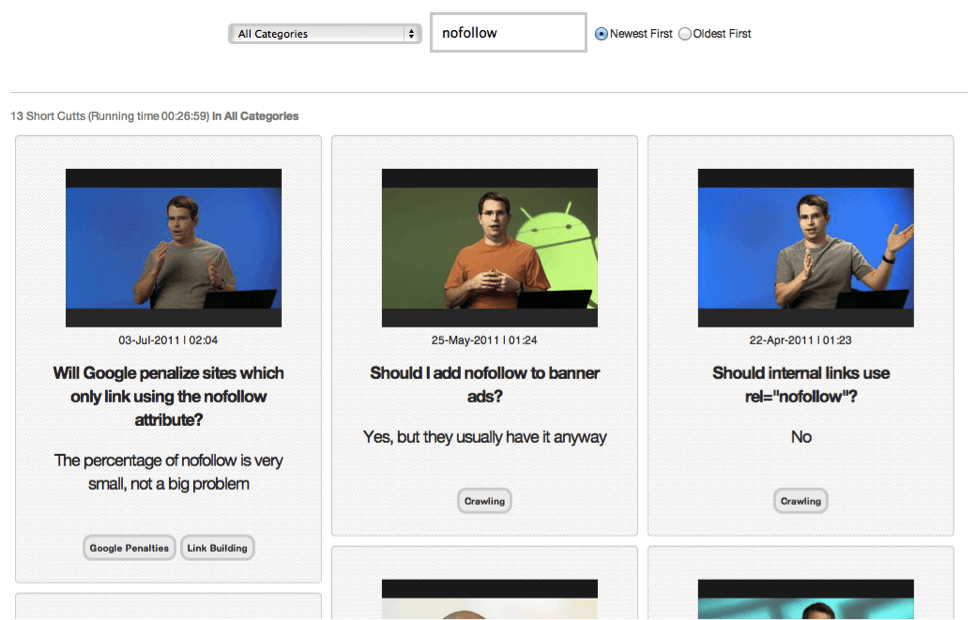
To be honest, you can probably figure out how to use the site just by looking at the page for 5 seconds, but here is a breakdown of the four different components (and a screenshot) for a little Tuesday afternoon reading:
  1. Search an SEO Question. As with any directory, you have a search bar where you will want to type in any SEO question that you have. If Cutts has created a video about anything similar, it (or they) will pop up on the screen in a grid-like format. You can sort whether you want to see the newest or the oldest videos first.
  2. Choose a Category. You can decide which category you want to search in to find a video. You can search all categories (which is what I usually do), but if it’s something general you might want to narrow it down. A few of the categories available include Link Building, SERPs, Google Updates, and even Matt Cutts Trivia.
  3. The Video. As you likely assumed, one part of the results is going to be the actual video, which you can click and watch right there on the same page.
  4. Text for the Video. The second part of your results is going to be the question followed by a very short answer. In some cases, the answer will just be a simple yes or no. It’s the best way for you to get what you need without having to watch the video (sometimes even 2 minutes is longer than you need!)
Below is a screenshot I took that illustrates all three parts of the site. As you can see, I typed in the search query “nofollow links” and sorted by newest first (of course feel free to be more specific, but something general will yield a lot of example results):
 sej 1
As you can see, I decided to search under “All Categories.” If I wanted to change my mind, I could click the one of the categories shown under the question and then sort by that particular category. In the example above, the first video is a part of two different categories—Google Penalties and Link Building.
You can find this directory at TheShortCutts.com. Scroll down just a little bit (past the cartoon of Cutts) and you can get started searching. Let us know what you think!
Photo Credit: TheShortCutts.com

A Beginner’s Guide to Unsuccessful Link Building: SEO

Author’s note: This is just a heads up that I have decided to exclude both the outreach process and content generation from this article for two main reasons. Firstly, they are both huge topics which are covered in far more depth, and detail, elsewhere than I could ever hope to do. Secondly, I’m approaching this topic with the assumption that you are already getting
content published and are building relationships with bloggers etc.
So you’ve built as many links as it is humanly possible to do. All the links have good anchor text, are well positioned and are placed on decent sites. Job well done.
As you head to the office the next day you anticipate a fanfare of trumpets, lavish gifts and perhaps even a throne. All because web traffic has quadrupled overnight, domain authority has hit a record high and sales are through the roof.
In reality though, you are sent crashing back down to Earth. Traffic continues to plod along as usual, completely indifferent to your efforts, whilst the unchanged domain authority and sales figures, merely mock the hope that is slowly fading from your eyes.
Alas my friend, that is as good a sign as any that your link building strategy needs some work. It could just be a bit of tweaking or it could be a full blown overhaul (fingers crossed for the former).
Have no fear though, because below are 11 reasons why your link building isn’t working and a few tips on how to stop it from…well…not working!
All you need is a little patience
In the world of SEO it can sometimes take a little while for things to take effect, so before doing anything rash I recommend patience. There isn’t much you can do to speed it up anyway – after all Google doesn’t really like people telling them what to do.
Your competitors are making you suck
If you need a scapegoat for the poor performance of your links look no further than your competitor. Granted that’s probably not the right attitude, but the excuse still stands…kind of.
dillbert comic
If your link building strategy isn’t going as planned then it could just be down to your pesky competitor’s strategy being better. If that’s the case then be prepared to out think, or out spend (not by buying links of course), in order to get a foot up.
Occam’s razor
Often the simplest, and most obvious, theory is the correct one. It is easy to overlook simple mistakes that are having a negative effect on your link building strategy. This is why, once you have a guest post, infographic or whatever piece of content you’ve used published, it is always worth going back to the site to have a look. This way you rule out any silly mistakes like typos in the url, anchor text or even no link at all.
Panda got your tongue?
From time to time you’ll find that your rankings may drop or your links may lose value for no obvious reason. This could be down to a number of reasons, but one of the first things you could check for is any algorithmic updates. These usually aren’t too difficult to find out about although there are rumours that Google will no longer broadcast or confirm their algorithmic updates. Once found, you will hopefully be able to identify the reasons for the recent drop in rankings etc.
panda
Your links aren’t as good as you thought
Now I’m not in the counsels of the great at Google, which is why I don’t profess to know how their algorithm works. However, if you were under the impression that you had authoritative sites linking to you but see no improvements in rankings, domain authority etc. It may be time to rethink where you’re trying to get links from/placing links.
Be original
If your link building campaign is based on using duplicate, or spun, content odds are you’re getting links from low quality, half spammy, sites which may, at least partially, explain poor results.
Onsite issues
Your link building campaign might not suck just because of your links. It is possible that there are other factors at work on your site that are damaging your offsite efforts. For starters check Webmaster Tools to see if Google have sent you any messages or issued any warnings. I’d also suggest running Screaming Frog to see if there are any broken links or site errors that could be affecting your link building. After all if you’ve been building loads of links to a page that has a 404, then it’s no wonder that you aren’t getting much joy.
Irrelevant site or content
As a general rule getting a link on a site that has little or no relevance isn’t particularly useful to a link builder. Although it will probably still pass link authority it is unlikely to help in achieving other aims such as increasing web traffic and conversions. Obviously if a really high profile site offers you a link then don’t turn it down, but be wary of having too many irrelevant sites pointing to yours.
Co-citation
This is a relatively new concept in SEO, but the esteemed Rand Fishkin boldly predicted that co-citation’s present influence – which is relatively small – will increase in the next few years. For those who don’t know what co-citation is I’ll explain it very briefly. In SEO, co-citation refers to the effect the content surrounding a link/keyword/brand has on SERPs. For example if Company A is a bakery and they keep getting mentioned/linked to in articles about cakes in London etc, then it may not be a surprise to see Company A sneak up the rankings for those, and other related, search terms. Why? Because Google has picked up that Company A is commonly associated with cakes etc and therefore believes it is a relevant result to show up for people using the appropriate search terms.
Interlink your content
It is important to try to interlink your content/website. For example if I’m writing an article on Site A and I remember that a few months ago I wrote an article that covers something relevant on Site B. Then it’s best practice to include a link from A to B so the link authority passes from one to the other; all whilst providing a legitimate link for users. As with most SEO tactics interlinking, or horizontal linking, is open to abuse and manipulation; so don’t go crazy and link to every site you’ve ever heard of in a 300 word post about apples.
DA isn’t the be all and end all
Link builders beware of domain authority. Although it is a great indicator of how Google sees a site’s authority it should be viewed with caution when it comes to link building. Mainly because it doesn’t take a site’s traffic, social metrics and user interaction into account. But just because SEOMoz doesn’t, it doesn’t mean you can’t – after all you can see, and qualify, things that no crawler can. Or if you don’t want to do it Inkybee is a relatively new tool that helps link builders to qualify a large number of websites at a time – think Buzzstream on steroids.
Anything to add?
Do you have anything to add? Think I’ve missed something out? Feel free to jump in with your two cents worth; I’d be interested to hear everyone’s thoughts…